JADEITE BANGLES,
UNDERSTOOD PROPERLY
At Ixchell Jewellery, we specialise in natural Type A Burmese jadeite bangles — quietly curated for clients who prefer clarity, provenance, and proper viewing before choosing.
Learn the design. Understand the colour. Fit the size. Read the heritage. Then view the real piece.
1 Coleman Street · The Adelphi #02-33 · Opposite Funan · Nearest MRT: City Hall
Most people choose a jadeite bangle by colour first. That is understandable — but it is not the most complete way to choose.
WHAT IS A JADEITE BANGLE?
A jadeite bangle is a continuous circular form carved from jadeite and worn directly on the wrist. It is valued not only for its appearance, but for the balance between colour, translucency, texture, proportion, and structure.
Because a bangle is usually cut from a single piece of stone, it reveals the quality of the material very honestly. A fine bangle cannot hide poor structure easily.
In short: a jadeite bangle is one of the most complete expressions of jadeite.
WHAT TYPES OF JADEITE BANGLES ARE THERE?
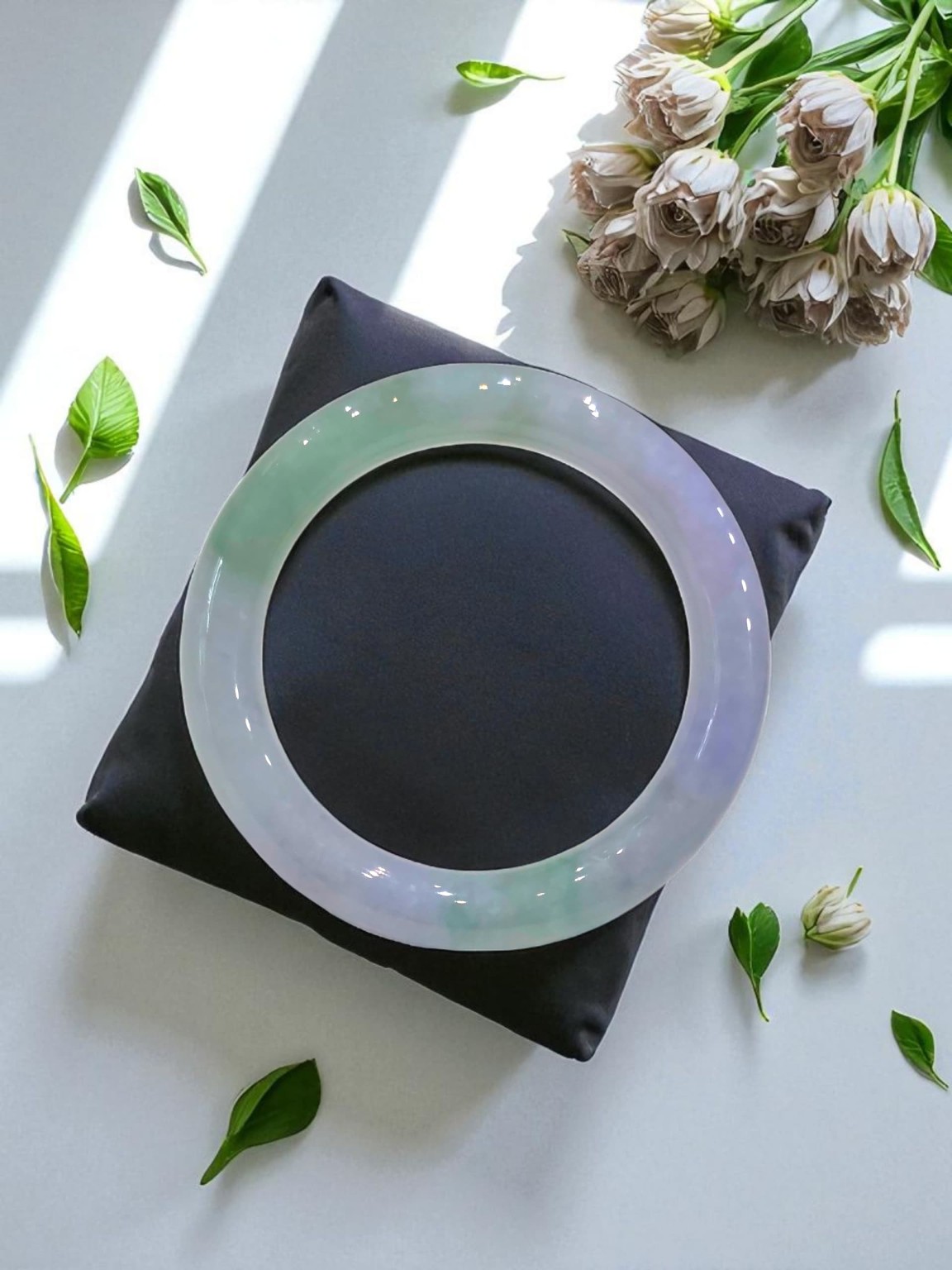
The main types include round bangles, flat bangles, oval or princess bangles, and carved bangles. Each design changes how the bangle looks, feels, and sits on the wrist.
ROUND BANGLE
A round jadeite bangle has a classic circular profile. It feels traditional, weighty, and balanced.
FLAT BANGLE
A flat bangle usually sits closer to the wrist and may feel more comfortable for daily wear.
OVAL BANGLE
An oval or princess bangle follows the natural shape of the wrist more closely.
CARVED BANGLE
A carved jadeite bangle carries artistic movement and symbolism. Carving can be deliberate design and cultural expression.
CONTEMPORARY FORMS
Some jadeite bangles are styled with modern proportions for refined daily wear.
DESIGN AFFECTS COMFORT
Two bangles with the same inner diameter can feel different depending on shape, thickness, and width.
WHAT COLOURS DO JADEITE BANGLES COME IN?
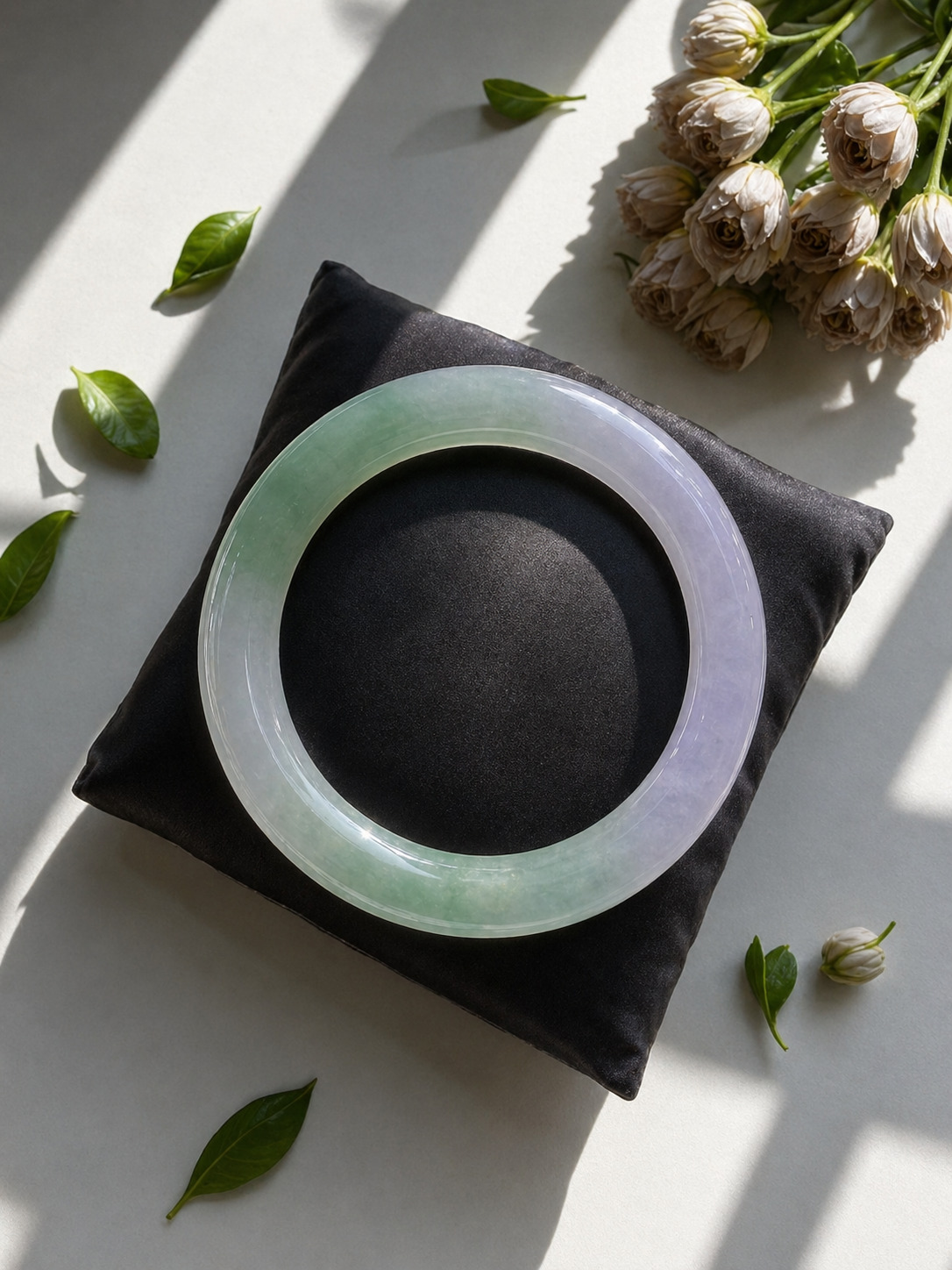
Jadeite bangles may appear in green, lavender, icy white, yellow, red, dark tones, and multi-colour combinations such as 春帶彩. Colour draws the eye, but it should not be the only reason for choosing.
A strong colour without good texture or proportion may not feel refined. A softer colour with excellent translucency and balance may feel far more elegant in person.
Colour begins the conversation. Balance completes it.
WHAT DOES EACH JADEITE BANGLE COLOUR SUGGEST?
GREEN JADEITE
Green jadeite is often associated with vitality, prosperity, and classic jadeite value.
LAVENDER JADEITE
Lavender jadeite feels gentle, elegant, and quietly feminine.
ICY WHITE JADEITE
Icy white jadeite suggests clarity, calm, and restraint.
YELLOW JADEITE
Yellow jadeite may feel warm, auspicious, and distinctive.
SPRING COLOUR JADEITE
春帶彩 combines green and lavender tones, creating a poetic balance of vitality and softness.
DARK JADEITE
Dark jadeite and 墨翠-style tones can feel powerful, grounded, and modern.
WHAT SIZE JADEITE BANGLE SHOULD I CHOOSE?
Jadeite bangle size is determined mainly by inner diameter, usually measured in millimetres. However, comfort is not decided by diameter alone.
Width, thickness, hand shape, knuckle structure, and how the bangle passes over the hand all matter. A bangle should slide on with gentle resistance and rest comfortably on the wrist.
In short: size is measurement plus comfort, not measurement alone.

A JADEITE BANGLE IS NOT ONLY WORN. IT IS LIVED WITH.
WHY ARE JADEITE BANGLES IMPORTANT IN HISTORY AND CULTURE?
Jadeite bangles have long been connected with protection, continuity, family heritage, and personal blessing across Chinese and Southeast Asian Chinese cultures.
In many families, a bangle is not treated as a passing fashion object. It may be worn daily, kept carefully, gifted at important moments, or passed from one generation to another.
You do not merely own a jadeite bangle. You keep it for the next generation.
WHY DID JADEITE BANGLES BECOME DEEPLY CONNECTED WITH SOUTHEAST ASIAN CHINESE FAMILIES?
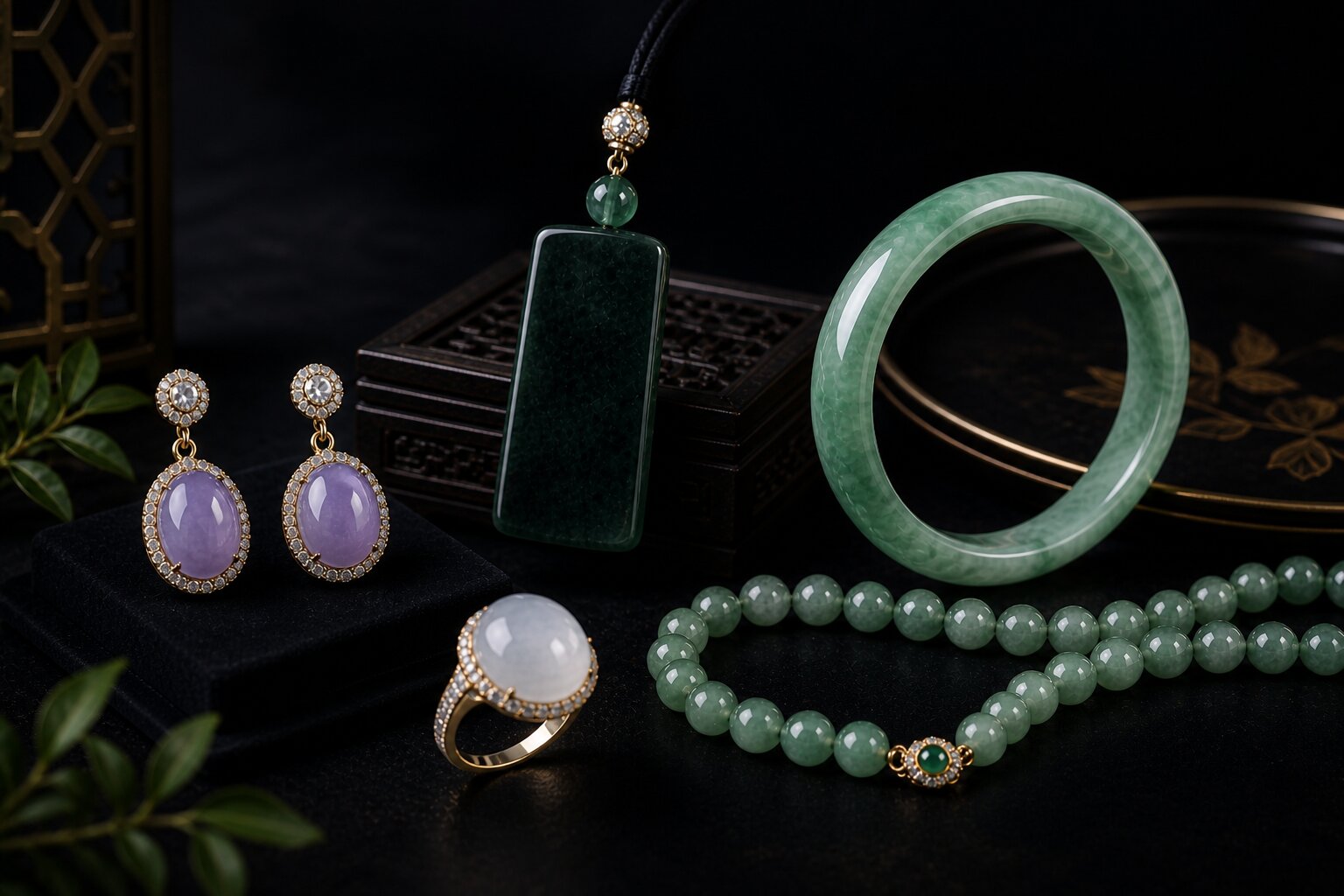
Across much of Southeast Asia, particularly within Chinese migrant communities, the jadeite bangle gradually became more than jewellery. It evolved into a symbol of continuity, feminine stewardship, family stability, dowry culture, and wearable inheritance.
This was especially visible amongst Peranakan Chinese communities, Hakka households, Hokkien merchant families, Cantonese migrants, and overseas Chinese societies established throughout Singapore, Malaya, Sarawak, Sabah, Indonesia, Thailand, Vietnam, Hong Kong, Taiwan, and the wider Nanyang world.
In many families, a jadeite bangle represented trust, family continuity, blessing, status, emotional memory, and at times even a discreet form of movable family wealth during periods of migration and uncertainty.
The jadeite bangle became part of the cultural memory of migration itself.

WHY ARE STRONG HAKKA WOMEN OFTEN ASSOCIATED WITH JADEITE BANGLES?
Historically, traditional Hakka society remained structurally patriarchal in lineage and ancestry. However, the practical realities of migration, survival, and household management often placed extraordinary responsibility upon women.
Across generations, many Hakka men travelled throughout the Nanyang region seeking work, trade opportunities, agricultural livelihoods, or economic stability abroad. In their absence, women became the operational backbone of the household.
Unlike many Han Chinese communities of earlier periods, Hakka women were widely known for rejecting foot-binding traditions. Their ability to move freely and undertake demanding labour contributed to unusually strong practical authority within domestic life.
In many households, jadeite bangles became connected with feminine strength — representing stewardship, inheritance, continuity, and quiet authority passed from one generation to another.
The bangle was not merely worn. It represented the woman trusted to carry the household forward.
FROM MARITIME MIGRATION TO WEARABLE FAMILY WEALTH
During the maritime eras of Chinese migration into Southeast Asia, cultural traditions, jewellery practices, language groups, and family customs travelled alongside merchants, settlers, and trading communities.
Early Chinese jade culture was historically centred more around nephrite than Burmese jadeite. During the time of Zheng He and earlier maritime movements across Java, Malacca, Borneo, Siam, and the Indonesian archipelago, nephrite traditions remained more familiar within Chinese society.
The widespread prestige of Burmese jadeite emerged later, particularly during the Qing Dynasty, when imperial interest and expanding Yunnan-Burma trade routes elevated jadeite into elite Chinese culture.
As overseas Chinese communities across Southeast Asia grew more established, jadeite bangles gradually evolved into heirloom objects associated with dowry, inheritance, stability, status, and long-term family continuity.
The value of a jadeite bangle was often emotional, cultural, and practical all at once.
DID JAVANESE AND BALINESE ROYALTY TRADITIONALLY WEAR JADEITE BANGLES?
Historically, jadeite bangles were not central to the traditional royal regalia of Javanese or Balinese courts.
The royal cultures of Java and Bali developed their own sophisticated traditions of adornment rooted in Hindu-Buddhist court aesthetics, local spiritual systems, and later Islamic influences.
Javanese keratons and Balinese royal houses typically favoured elaborate gold craftsmanship, ceremonial kris symbolism, diamonds, rubies, ornate crowns, silverwork, and intricate metal artistry rather than jadeite bangle traditions.
Jadeite remained culturally more associated with Chinese identity, migrant family systems, and Peranakan heritage rather than indigenous royal ceremonial dress.
Jadeite became one of the strongest visual languages of overseas Chinese cultural continuity across Southeast Asia.
IS A JADEITE BANGLE STILL FASHIONABLE TODAY?
Today, a jadeite bangle is no longer only traditional. It can also be a modern fashion statement — quiet, intelligent, and deeply personal.
It may be worn with a crisp white shirt, a tailored blazer, a linen dress, or even beside a watch. The effect is not loud luxury. It is heritage elegance.
For modern women, jadeite can feel like identity rather than decoration.
A fine bangle does not chase fashion. It outlives it.

CAN I WEAR A JADEITE BANGLE IN A HOT SHOWER OR ONSEN?
Natural Type A jadeite is a stable mineral and is generally not affected by water or normal heat exposure such as showers or onsen. Very high heat, sudden temperature changes, or accidental impact against hard surfaces should still be approached carefully, as with all fine jewellery.
STABLE MATERIAL
Natural Type A jadeite retains its original mineral structure.
WHY SOME SELLERS WARN AGAINST HEAT
Some advice may come from concern over treated jadeite, resin-filled material, or settings that may not tolerate heat and moisture well.
OUR PRACTICAL POSITION
The concern is not jadeite itself, but the integrity of the material. A well-selected Type A jadeite bangle is made to be worn, not avoided.
HOW DO I CHOOSE THE RIGHT JADEITE BANGLE?
Start with Type A jadeite. Then consider colour, translucency, texture, proportion, size, lifestyle, skin tone, and how the bangle feels on you.
Most people begin with colour. A better approach is balance. The right bangle should not only look beautiful; it should feel natural on the wrist and suit your life.
For a fuller buying framework, read our guide: HOW TO CHOOSE JADEITE PROPERLY.
The right bangle is not always the loudest one. It is the one that stays in your mind.

WHERE CAN I BUY A REAL JADEITE BANGLE IN SINGAPORE?
Ixchell Jewellery is a private jadeite boutique at The Adelphi #02-33, 1 Coleman Street, Singapore. We are opposite Funan, with City Hall MRT as the nearest MRT.
We specialise in natural Type A Burmese jadeite jewellery and offer private viewing by appointment so clients may compare pieces calmly and properly.
Before viewing, you may share your preferred bangle size, colour, budget direction, and style so we can prepare suitable trays for your visit.
You are welcome to ask simple questions. Jadeite should feel fascinating, not intimidating.
VIEW JADEITE PROPERLY, NOT QUICKLY.
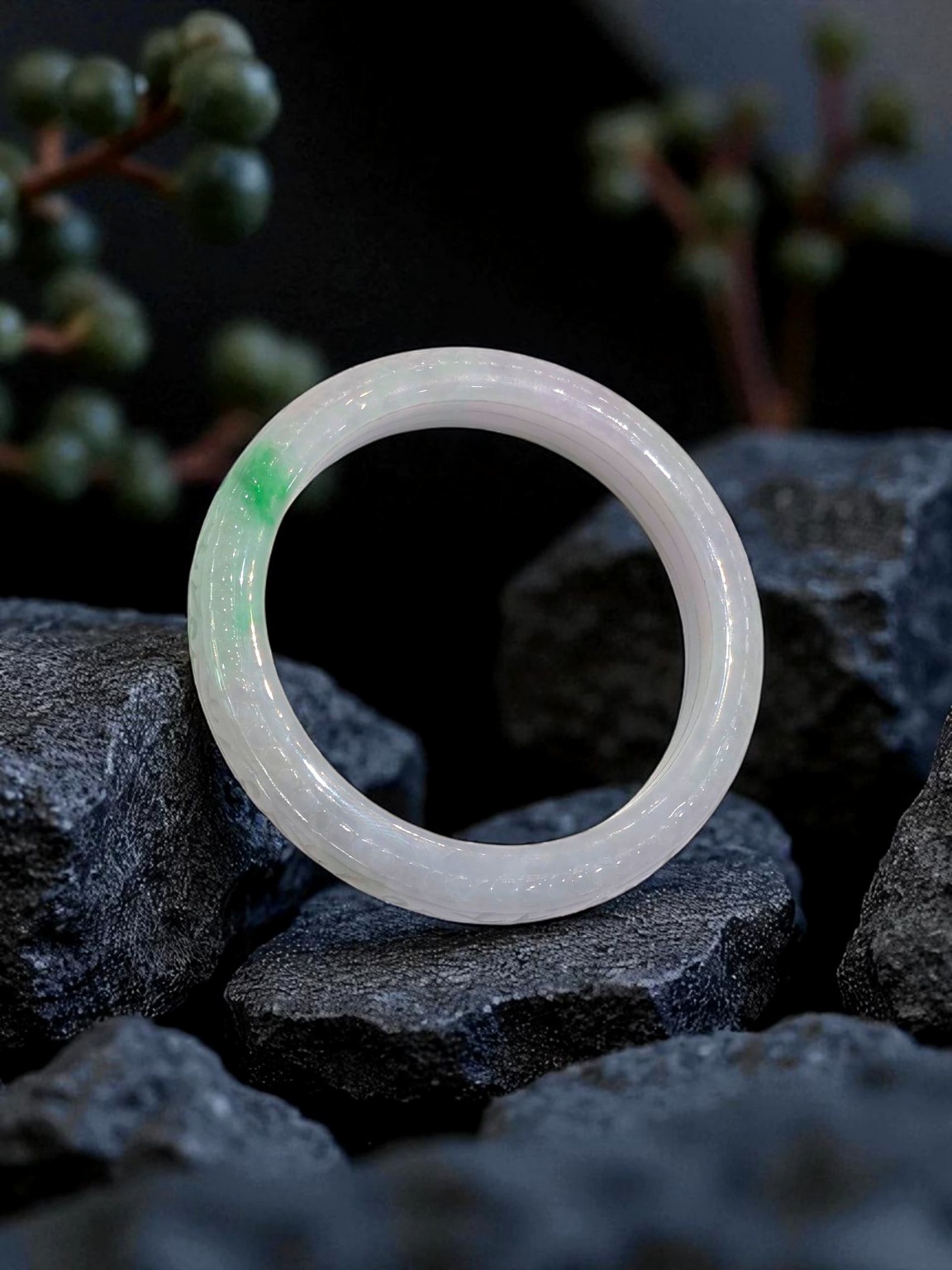
Images can introduce jadeite, but in-person viewing reveals its true character. We welcome you to visit our private boutique at The Adelphi #02-33, opposite Funan and near City Hall MRT, by appointment.
Kindly contact us on WhatsApp or Instagram to arrange a private viewing. You are welcome to ask questions before visiting.