ROOM III

Understanding Value

The connoisseur’s 6-pillar framework. We train your eye to read the physics of light, recognise structural integrity, and navigate the true metrics of high-grade lapidary investment.

PILLAR 01

The Physics of Water

種水 (Zhong Shui)

Before colour, there is Water. This refers to the stone's translucency and its ability to refract light. It is dictated by how tightly packed the microcrystalline structure of the Type A jadeite is.

An "Icy" piece has exceptionally high Water, allowing ambient light to pass deeply into the stone and bounce back, creating an internal glow. A piece with poor Water appears opaque and heavy. High Water is exceedingly rare, which is why a pure, colourless Icy bangle can command a higher price than an opaque green one.
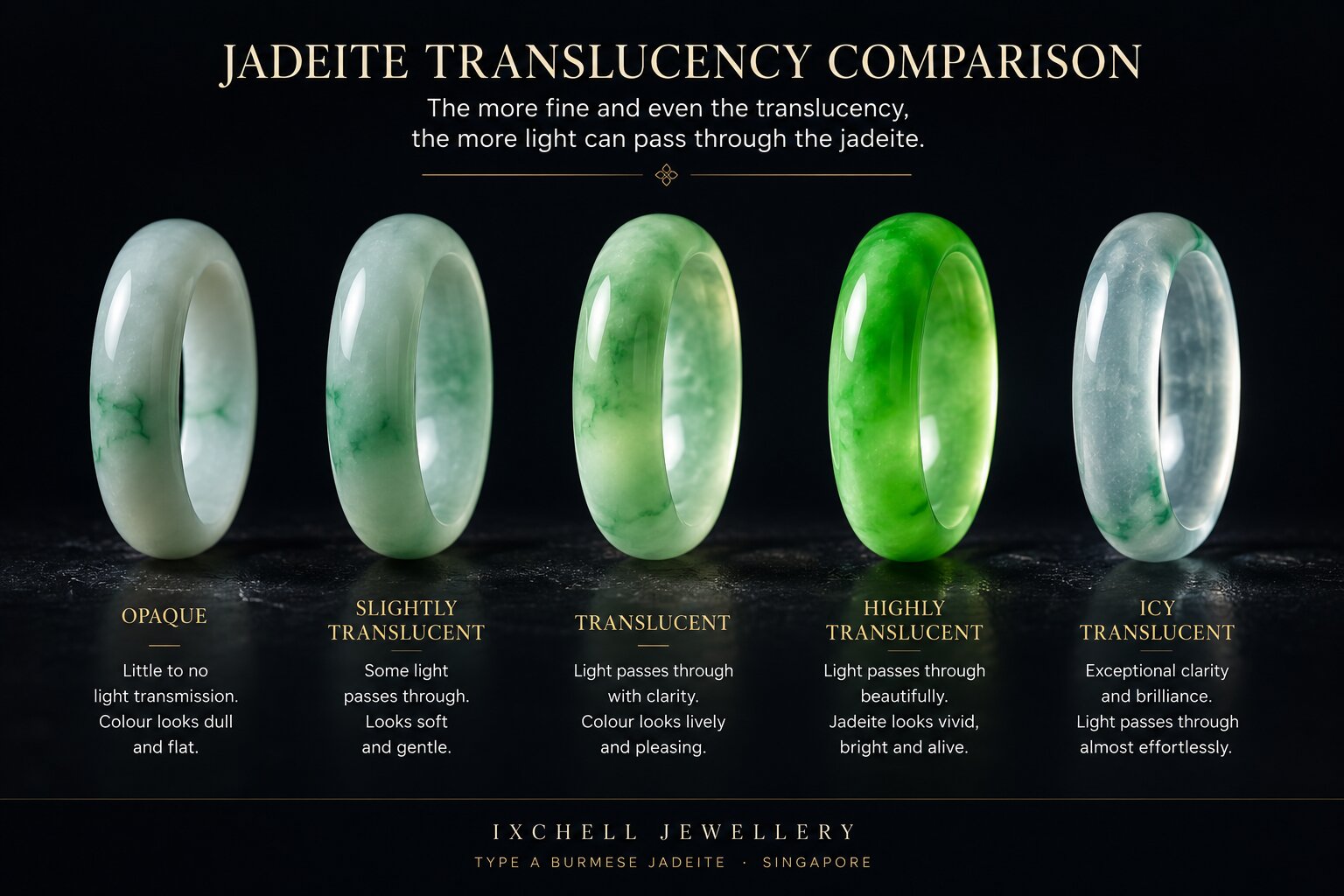
Jadeite Translucency Comparison
PILLAR 02

The Canvas of the Base

底 (Di)

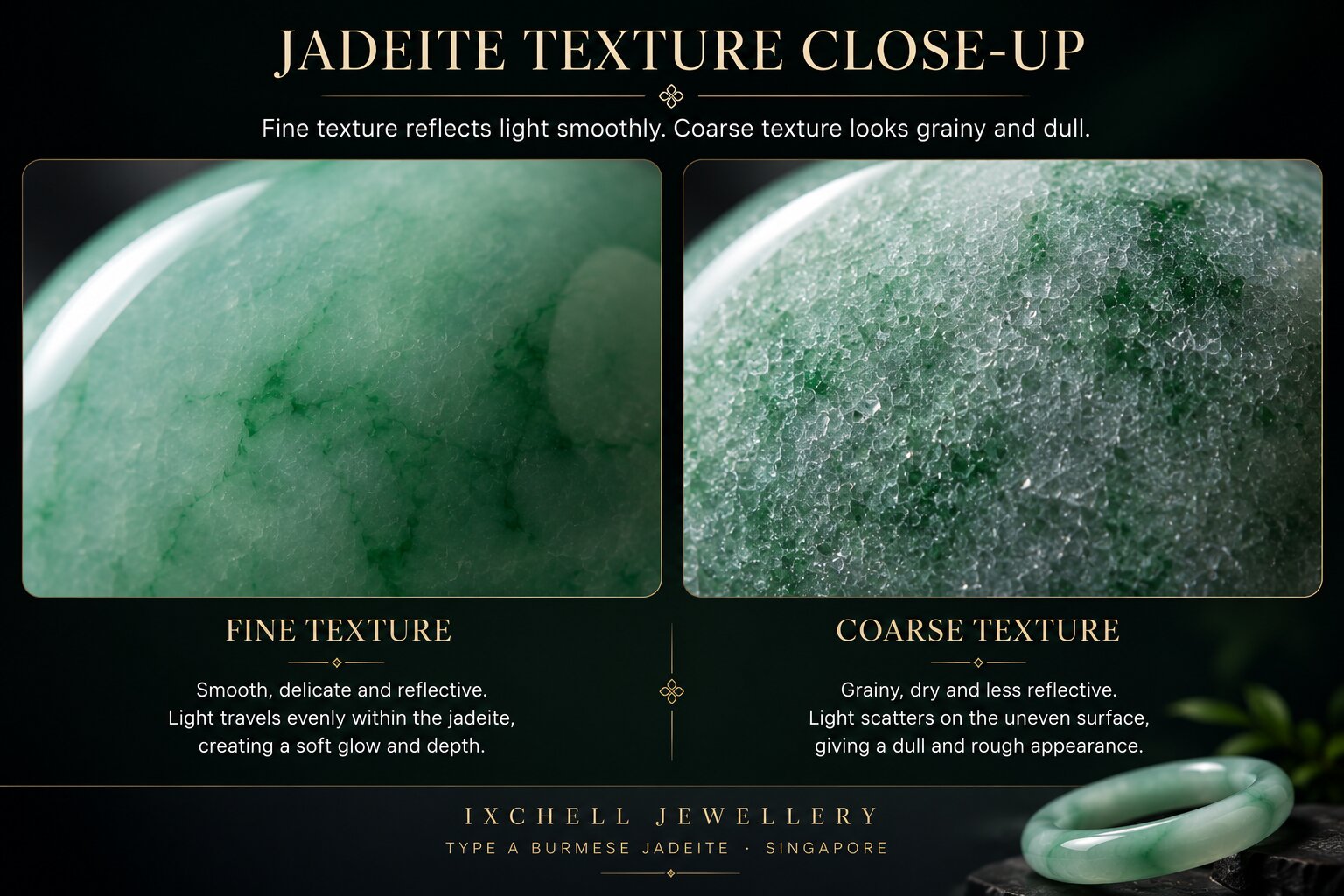
The Base is the underlying "canvas" of the stone. A fine Base is silky and homogenous, while a coarse Base appears grainy to the naked eye.

This is also where we evaluate the presence of "Cotton" (棉)—internal white crystalline inclusions that resemble wisps of cloud. While excessive cotton can disrupt translucency, beautifully distributed cotton (such as the highly prized "Snowflake Cotton" from the Mu Na mines) elevates the stone into a piece of natural art.

Jadeite Texture Close-Up Comparison
PILLAR 03

The Truth of Colour

色 (Se)

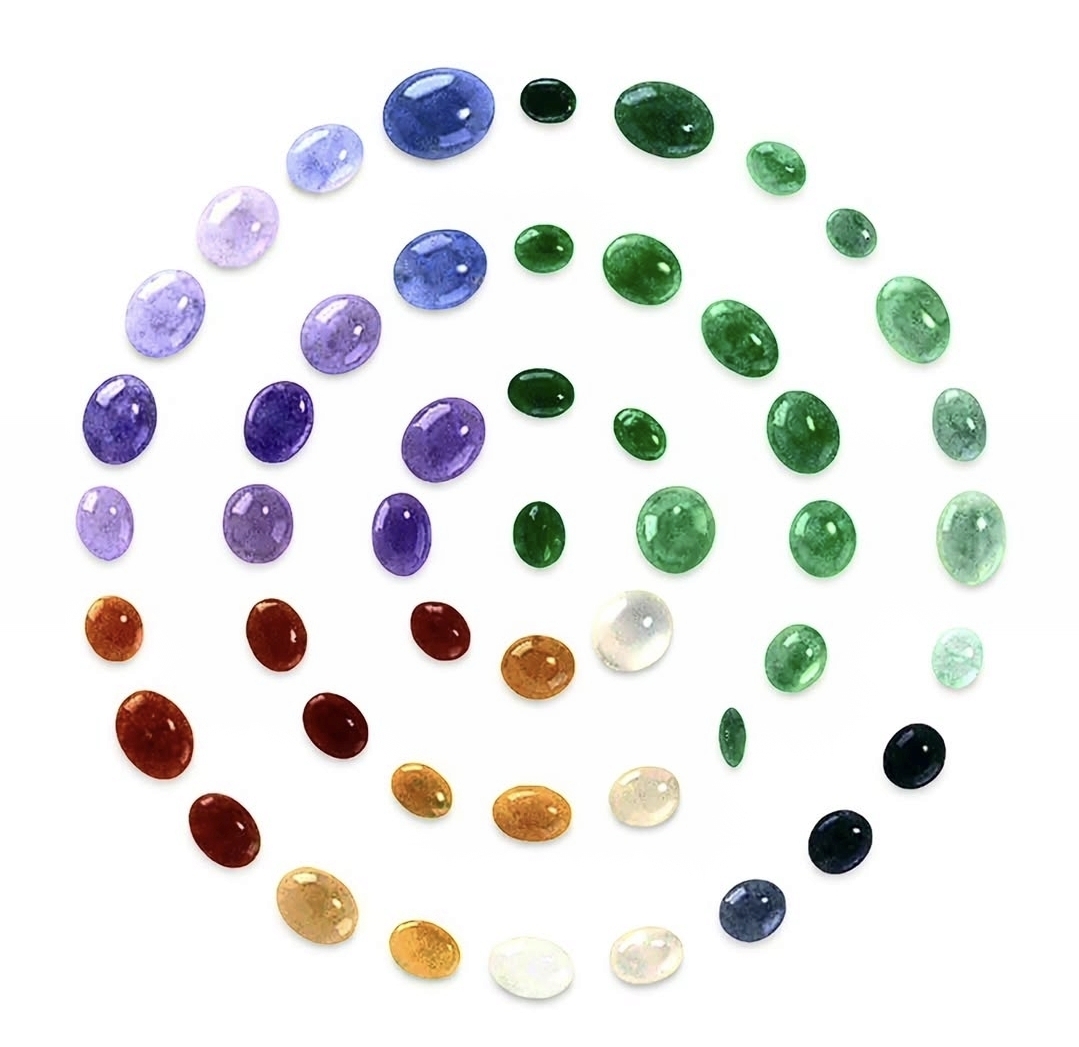
Colour is evaluated by its saturation, tone, and evenness. Whether it is the commanding Imperial Green (driven by chromium) or the delicate Lavender (driven by manganese), the colour must feel alive.

The Digital Illusion

Evaluating colour online is dangerous. Digital "beauty filters" and ring-lights artificially inject saturation into photos. This is why private viewing at our Adelphi boutique is critical; natural Type A jadeite acts as a chameleon, changing drastically between harsh indoor lighting and natural sunlight.

Type A Jadeite Colour Guide
PILLAR 04

Material Sacrifice & Thickness

工 / 厚度 (Gong / Hou Du)

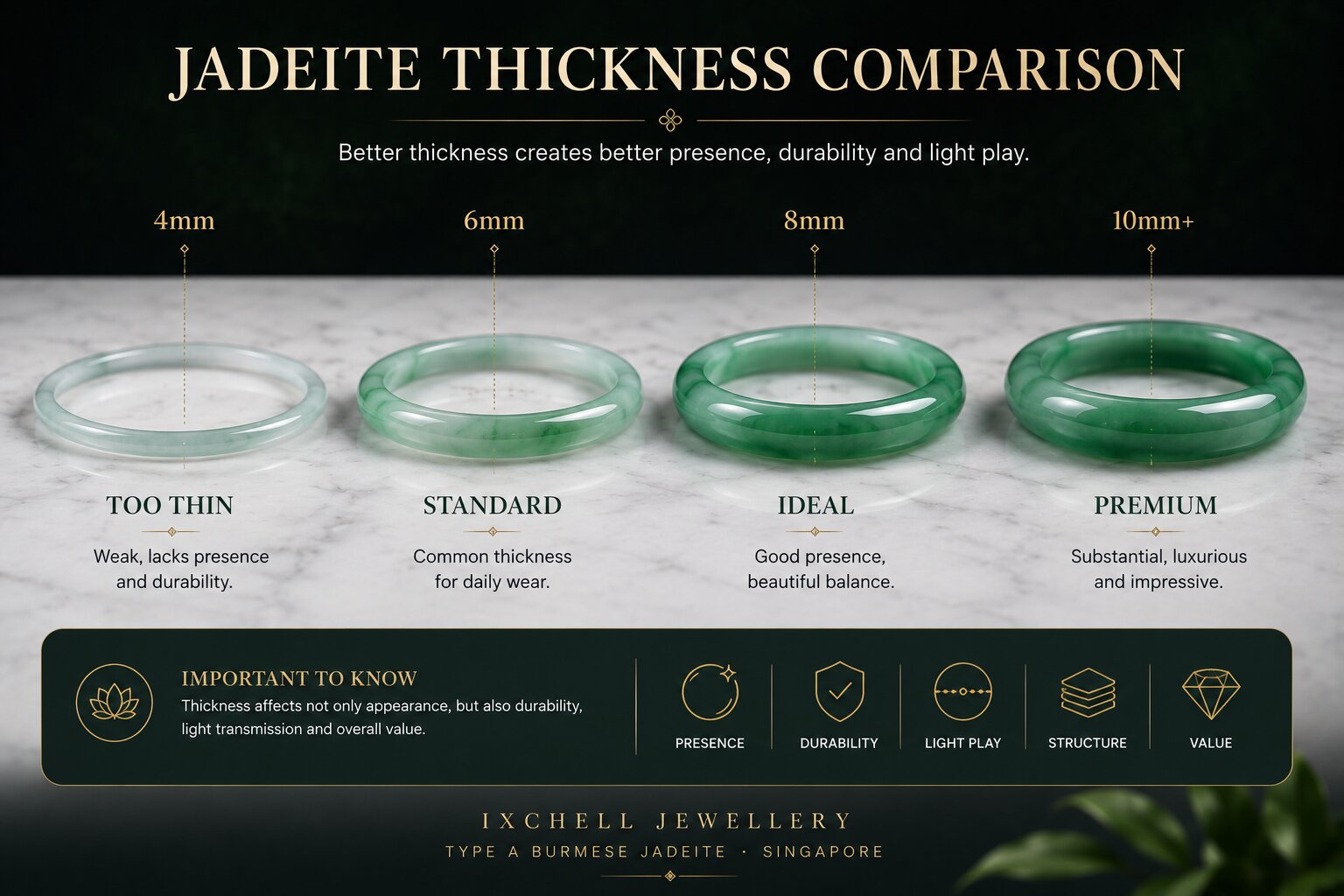
The thicker the cut, the exponentially higher the value, because it requires sacrificing more of the raw, expensive boulder.

The Eggshell Trap (廣片)

A common marketplace trick is the "Guang Pian" cut. Unscrupulous cutters will slice a piece of dark, opaque jadeite as thin as an eggshell. Suddenly, light easily passes through it, faking the illusion of high "Water." It is then set with a closed-back gold mounting to hide the severe lack of thickness. True value demands substantial, structural weight.

Jadeite Thickness Comparison
PILLAR 05

The Structural Truth

紋與裂 (Wen vs. Lie)

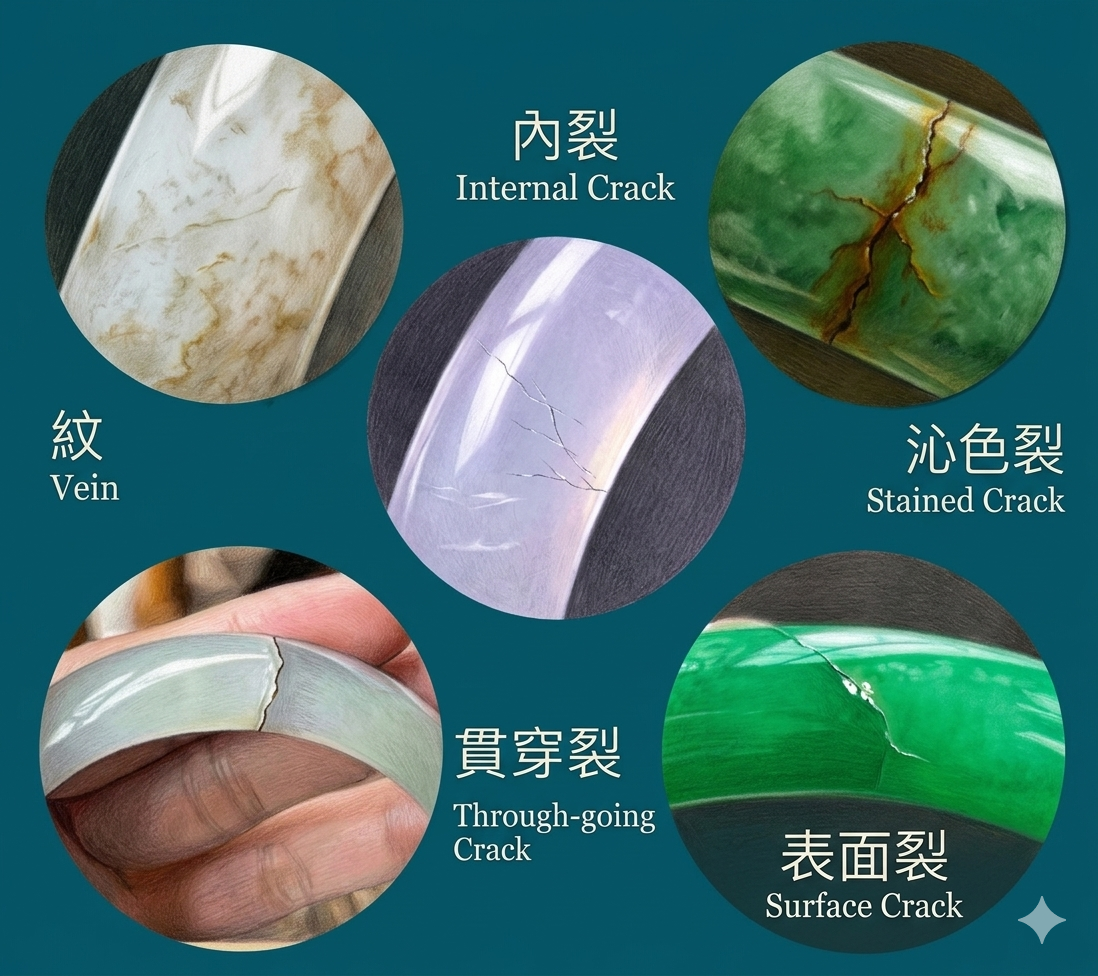
Nature is not flawless. It is crucial to distinguish between a harmless internal earth-born vein (紋), natural mineral pits (砂眼), and a structural trauma crack (裂) that compromises durability.

Beyond the Fingernail Test

Amateurs rely solely on the tactile "fingernail test" to feel for cracks, but this is dangerously inadequate. A standard protective wax coat can easily mask a severe surface crack, making it feel perfectly smooth—until the wax washes away over time. Conversely, a natural, harmless mineral pit might feel rough but poses no structural threat. True professional evaluation requires strong side-lighting to see if the stone's internal light path is severed, coupled with a 10x gemological loupe. This strict level of multi-layered verification is exactly why we mandate that all acquisitions take place at our physical boutique.

Jadeite Crack and Vein Classification
PILLAR 06

The Lapidary Finish

拋光 (Pao Guang)

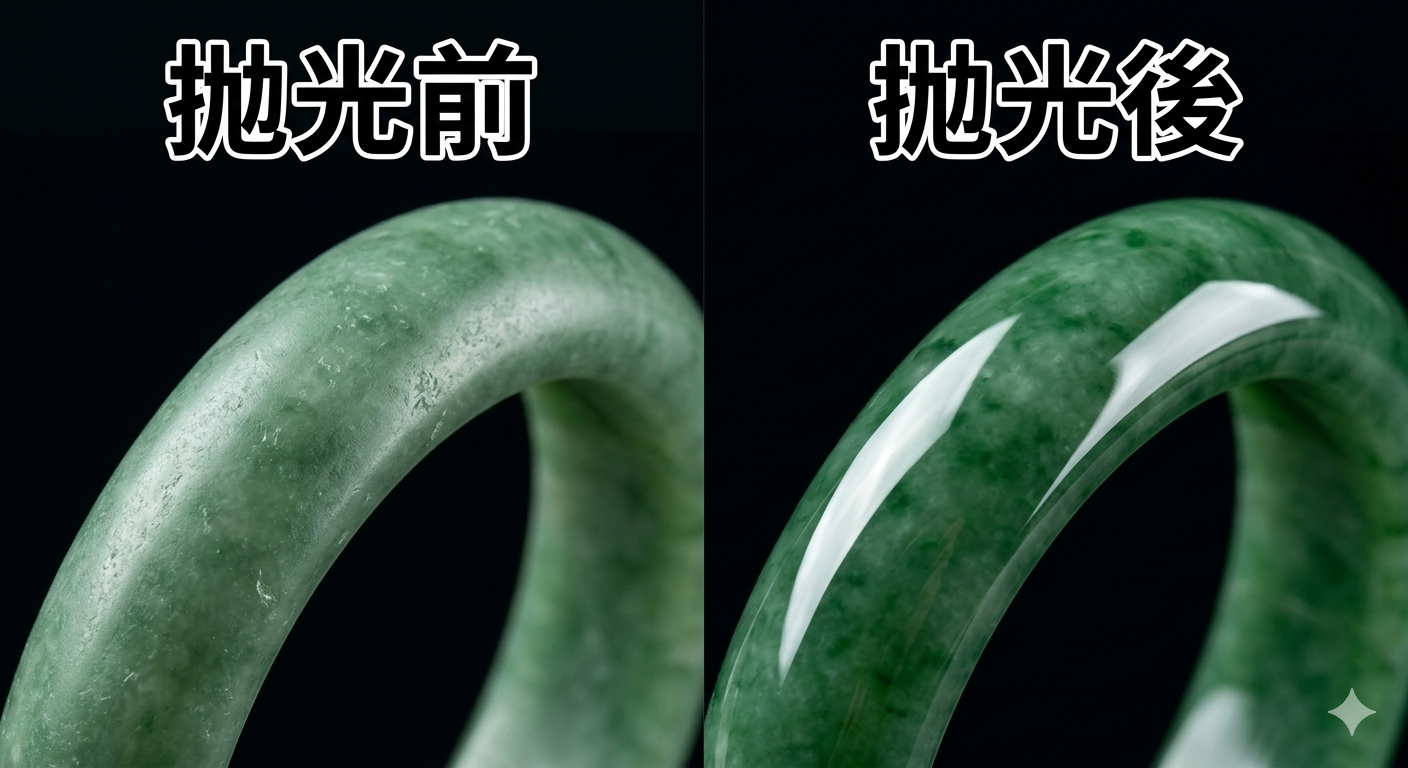
The final pillar is the artisan's touch. High-grade Type A jadeite is traditionally finished with a meticulous, mechanical friction polish using bamboo and diamond powder to bring out its glassy lustre.

A low-quality finish often relies on heavy coats of wax to artificially fill in poor surface carving or micro-porosity. A true master polish respects the 1.66 refractive index of the stone, allowing it to shine through its own inherent density rather than relying on surface coats.

Before and After Polishing Jadeite
CURATOR'S MASTERCLASS

The Six Pillars in Action

To fully master the metrics of jadeite investment, we look to the pinnacle of global lapidary transactions. Sourced from the May 2026 Christie's Hong Kong Magnificent Jewels auction, these two legendary bead necklaces provide a perfect case study in how our 6-pillar framework dictates ultimate value.

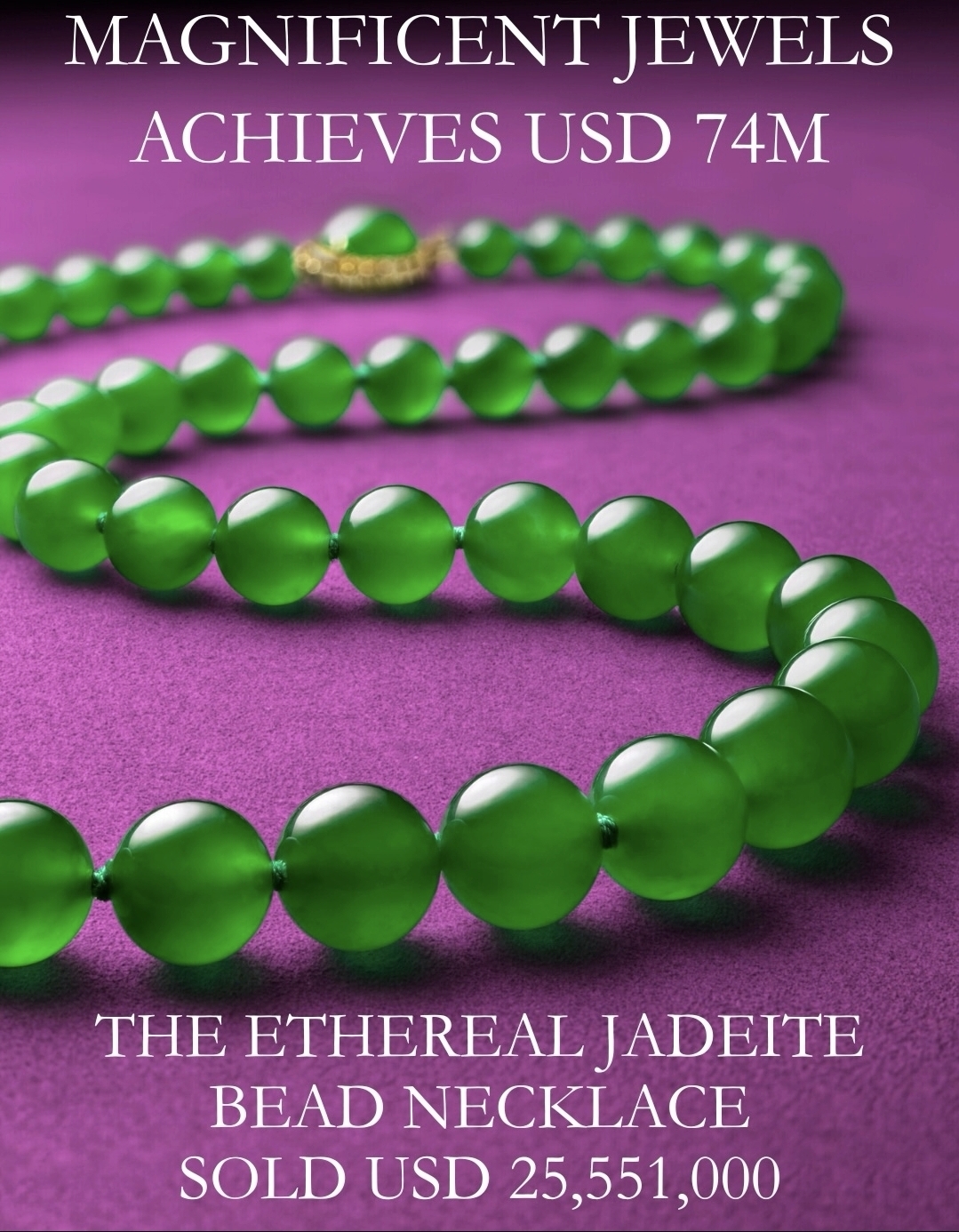
The Ethereal Jadeite Bead Necklace

The Ethereal Jadeite Necklace

Achieved: USD $25,551,000

Pillar 04 (Material Sacrifice): Comprising 61 massive graduating beads up to 13.7mm. Spheroid cutting demands the absolute maximum sacrifice of a raw boulder, making larger bead sizes exponentially rare.

Pillar 03 & 02 (Colour & Base): Sourcing 61 separate beads with identical, vibrant Imperial Green saturation and a completely flawless, silky internal Base from a single boulder is a monumental geological anomaly. The uniformity is so absolute that no gemstone spacers are used; the jadeite stands entirely on its own.

Pillar 01 & 06 (Water & Finish): Displays premier, glass-like translucency. The light behaves like liquid trapped within the stone, achieved through traditional master friction-polishing.

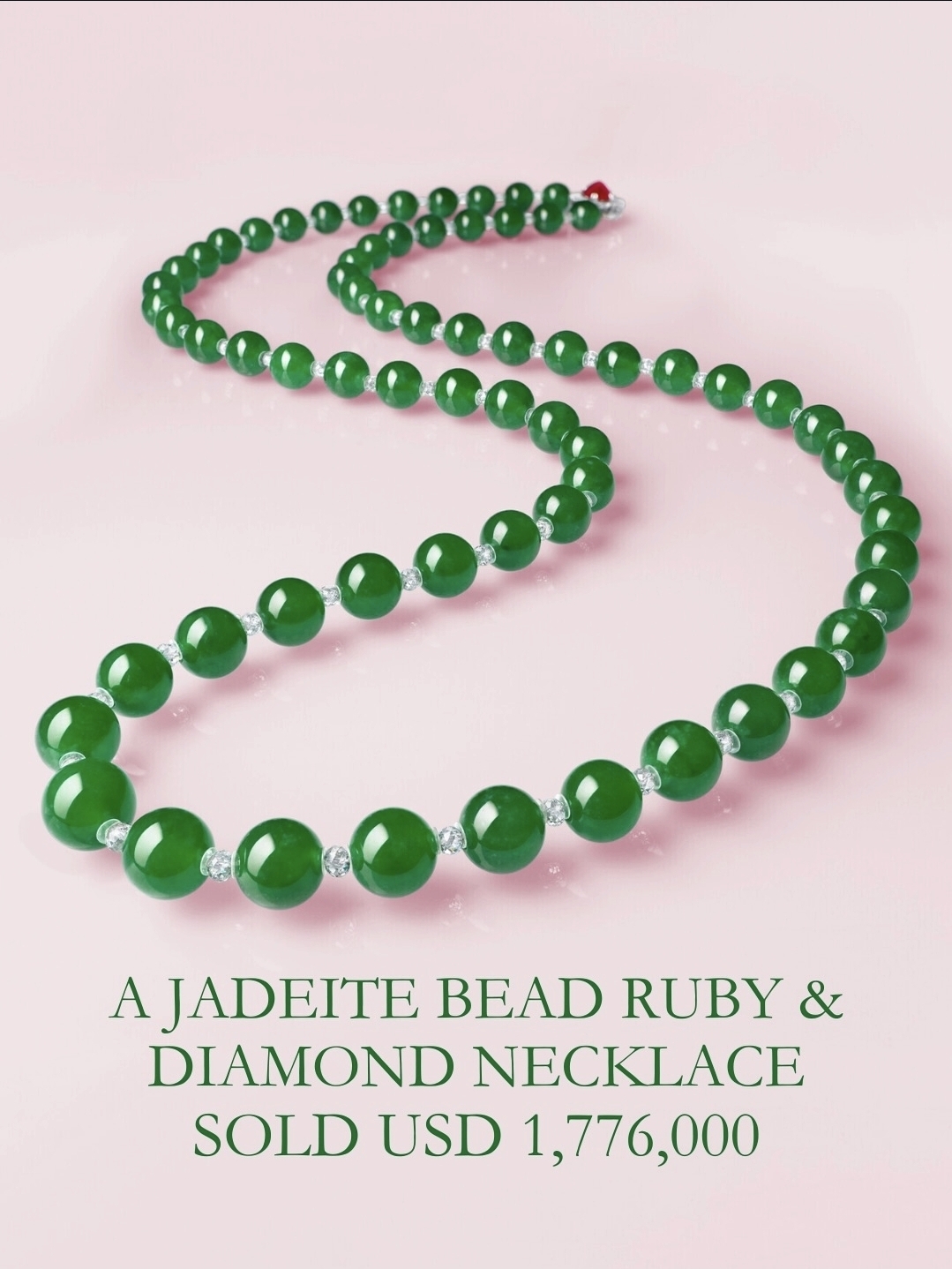
Jadeite Bead Ruby and Diamond Necklace

Jadeite Bead, Ruby & Diamond Necklace

Achieved: USD $1,776,000

Pillar 04 (Material Sacrifice): Comprising 68 beads graduating up to 11.0mm. While magnificent, a minor 2.7mm difference in peak bead diameter translates to significantly less raw volume cut away compared to the Ethereal layout.

Pillar 01 & 03 (Water & Colour Variance): This spectacular piece features deep, rich green hues and flawless structural integrity (Pillar 05). However, because matching near-translucent stones perfectly becomes exponentially more difficult with every shade variance, this layout incorporates brilliant diamond spacers and a 4.53ct sugarloaf Burmese ruby clasp to artfully frame and balance the design.

The Value Distinction: Both pieces represent structural perfection, but the massive price variance represents the financial premium placed on absolute, unassisted uniformity across massive dimensions.

A Note on Curatorial Appreciation

Disclaimer: The auction photographs featured in this case study were sourced from the official Instagram account of Christie's Jewels (@christiesjewels). All image copyrights are strictly reserved by Christie's. Ixchell Jewellery maintains completely independent operations and has no commercial ties, affiliations, or relationships with Christie's beyond being an enthusiastic follower of their public account. We present this structural analysis purely from a perspective of raw gemological appreciation, celebrating the historic moment these astonishing masterpieces of natural art have found their new homes.

Curator's Notes: Valuation FAQ

What gives jadeite its value?

Value is dictated by the 6-pillar framework: Water (translucency), Base (internal texture), Colour (saturation), Thickness (material sacrifice), Integrity (absence of cracks), and Craftsmanship.

Is the fingernail test reliable for finding cracks?

No. A standard wax coat can mask a dangerous surface crack, making it feel smooth, while harmless natural mineral pits can falsely feel rough. Professional evaluation demands a 10x loupe and strong side-lighting to check for internal light interruption.

What does "Water" (Zhong Shui) mean?

Water refers to the stone's translucency. An "Icy" piece has high Water, allowing light to pass deeply into the microcrystalline structure, making it highly valuable even without strong colour.

WhatsApp Us
Book Adventure